market report
North Carolina State Trends in Real Estate - July, 2026
Overview
North Carolina's real estate market has emerged as one of the strongest in the Southeast, driven largely by the rapid growth of the Charlotte and Raleigh–Durham metros and the expansion of secondary markets like Greensboro, Winston-Salem, Wilmington, and Asheville. Home values across the state have appreciated substantially over the past several years, with the statewide median sales price reaching roughly $383,000 in 2026 — up modestly year-over-year as the market has settled into a more balanced footing with inventory returning to healthier levels. The Charlotte region and the Research Triangle have seen some of the strongest demand, as remote workers and out-of-state transplants — particularly from the Northeast, the Midwest, and higher-cost coastal states — seek more affordable alternatives anchored by robust job markets in banking, technology, and life sciences. Rural land markets have also strengthened, with recreational and agricultural acreage across the Piedmont and eastern coastal plain attracting both in-state buyers and out-of-state investors drawn to North Carolina's relatively low property taxes, favorable use-value tax programs, and the state's varied geography spanning mountains, farmland, and coast. Coastal markets around Wilmington and the Outer Banks continue to command premium pricing, driven by tourism, second-home demand, and a growing retiree population, while the western mountains around Asheville remain highly desirable despite the disruption and rebuilding that followed Hurricane Helene. While elevated interest rates since 2022 cooled transaction volume statewide, North Carolina's nation-leading population growth and business-friendly environment have kept the market more resilient than most other states.
5-Year Outlook: North Carolina Vacant Land Investment
North Carolina vacant land presents a compelling investment case over the next five years, supported by several converging tailwinds that are unlikely to reverse in the near term. Population growth remains the foundational driver — the state led the entire nation in net domestic migration in the most recent year, adding residents at a pace that consistently outstrips the national average, and demand for developable land in the path of suburban expansion will continue to push values higher, particularly in the ring counties surrounding Charlotte and Raleigh and along the I-85 and I-40 corridors that connect the state's major employment centers. The continued relocation and expansion of major employers — anchored by Charlotte's standing as one of the largest banking centers in the country and by the Research Triangle Park's concentration of technology, pharmaceutical, and life-sciences firms — creates sustained pressure on land in secondary and tertiary markets within commuting distance of these nodes. Timberland and agricultural land across the Piedmont and coastal plain offer a different but equally attractive investment profile, providing income through timber harvests or crop leases while the underlying land appreciates quietly, and North Carolina's Present-Use Value program — which can reduce property taxes on qualifying forestry and farm tracts by as much as 90% — meaningfully improves the carrying economics of holding rural acreage, a combination that has historically produced steady risk-adjusted returns with low volatility relative to other asset classes. Coastal and mountain vacant land, particularly around Wilmington, the Outer Banks, and the Asheville–Blue Ridge corridor, faces constrained supply given natural boundaries and regulatory restrictions on new development, which should continue to support above-average appreciation for well-located parcels. The primary risks to monitor over the five-year window include sustained elevated interest rates that dampen developer appetite, tightening of environmental, wetlands, and coastal-development regulations that could impair build-out potential on certain parcels, intensifying hurricane and flood exposure along the coast and — as Helene demonstrated — in parts of the western mountains, and the possibility that remote-work normalization pulls some demand back toward urban cores. On balance, however, investors with a patient, five-year or longer horizon who focus on land in North Carolina's growth corridors, near infrastructure investment, or with timber and agricultural income potential are well-positioned to benefit from one of the most favorable state-level demographic and economic backdrops in the country.
Demographics
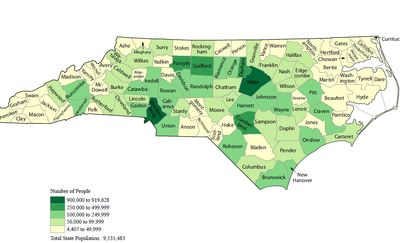
North Carolina is one of the fastest-growing states in the country, with a population now exceeding 11.2 million residents — the ninth largest state — and projections suggesting it will surpass both Georgia and Ohio to become the seventh most populous state by the early 2030s. The state's population is notably diverse — roughly 21% of residents identify as Black or African American, one of the larger shares in the nation, while Hispanic and Latino residents account for approximately 11% and a growing Asian American community, concentrated heavily in the Research Triangle and Charlotte suburbs, makes up a little over 3% and continues to expand. The median age in North Carolina sits around 39, close to the national median, reflecting a balance between an influx of working-age adults drawn by job opportunities and a substantial and growing retiree population settling in the mountains and along the coast. In-migration is the defining demographic story: North Carolina recorded the largest net domestic migration gain of any state in the most recent year, drawing new residents to job opportunities in banking, technology, life sciences, manufacturing, and logistics. The Charlotte and Raleigh–Durham metros function as the demographic engines of the state, capturing the bulk of recent population gains, while many rural counties in the east and far west continue to see population stagnation or modest decline as younger residents migrate toward urban job centers.